July 23
“A Storybook Dream
coming true”
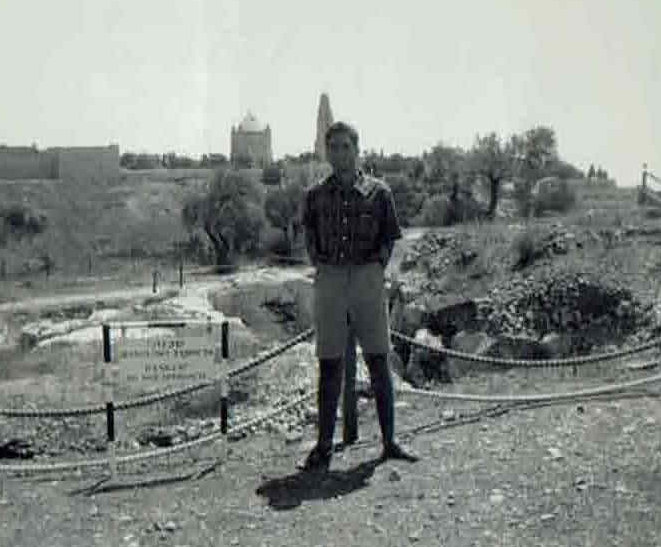
of Jerusalem
Bob’s first tour and the excitement of seeing the Israeli landscape for the first time.
Tuesday July 23, 1957, 2PM
Dear Folks,
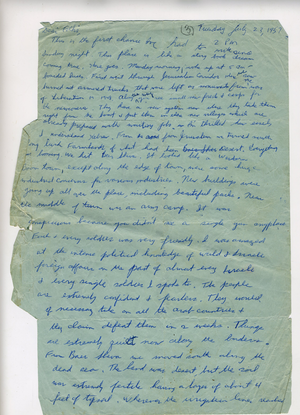
This is the first chance I’ve had to write since Sunday night. This place is like a story book dream coming true.
Here goes. Monday morning, I woke up at 5 AM. We boarded the buses. First we went through the Jerusalem Corridor where we saw burned armed trucks that were left as monuments from the War of Liberation in 1948. Along the way you see small new forests & camps for newcomers. They have a new system now where they take them right from the boat & put them in this new village which is already prepared with waiting jobs.
I’m thrilled how easily I understand Hebrew. From Jerusalem we turned south along lush farmlands of what had been desert. Everything was booming. We hit Beer Sheva. It looked like a Western Boom town, except along the edge of town, were some huge industrial concerns for various industries. New buildings were going up all over the place, including beautiful parks. Near the middle of town was an army camp. It was conspicuous because you didn’t see a single gun anyplace. Each and every soldier was very friendly. I was amazed at the intense political knowledge of world & Israeli foreign affairs, on the part of almost every Israeli, & every single soldier I spoke to. The people are extremely confident & fearless. They would if necessary take on all the Arab countries & the can defeat them in 2 weeks.
Things are extremely quiet now along the borders. From Be’er Sheva we moved south along the Dead Sea. The land was desert, but the soil was extremely fertile having a layer of about 4 feet of topsoil. Wherever the irrigation lines reached the land it was green with stalks of corn 12 & 15 feet high.
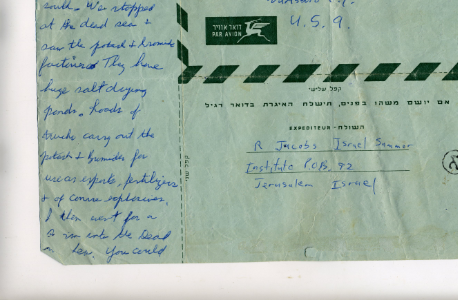
We saw the homes of the new immigrants who were settling in the South. We stopped at the Dead Sea and saw the potash & bromide factories. They have huge salt drying ponds. Loads of trucks carry out the Potash & Bromide for use as exports, fertilizers & of course explosives. I then went for a swim into the Dead Sea. You could stay on top of the water and can’t drown even if you wanted to. I swam almost a third of the way and paddled back on my back. It felt great.
On the way back we stopped at the goat crater which is about 13 miles & completely surrounded by mountains. It is here that huge mined resources have been found, including, iron, copper, magnesium, etc.
No More Space so….
Love to Everyone,
Bob
David’s Comments:
“This place is like a storybook dream coming true”
Seeing Israel for the first time was to Bob like a “Storybook come true.” My father had learned Bible stories as a young boy, and now he was seeing it for the first time in real life.
He wrote two letters to his parents in one day. The number of places he saw in one day is a story in itself. I have read many books on Israel and I have not read any book that gives detailed descriptions about the Negev, the Dead Sea, Beer Sheva the Jerusalem, Tel Aviv, kibbutzim and the northern part of the country etc., as my father did in his letters. Bob also described the factories and natural resources in each place.
“Here goes. Monday morning, I woke up at 5 AM. We boarded the buses.”
My dad wrote two letters on July 23rd. The first letter was at 2:00 pm, and the second letter was written late that night. He mentions that he woke up at 5:00 am to board the buses. In the second letter he mentions the buses returning back to Jerusalem at 2:00 AM.. That is a lot of touring – twenty-one hours of traveling in one day.
“First we went through the Jerusalem Corridor
When my father wrote “Jerusalem Corridor” he was referring to the part of the Corridor, or the road, that extended from Sha’ar HaGai (also known as ‘Bab el-Wad’ in Arabic) which is near Beit Shemesh, all the way up to the western entrance of Jerusalem.
This road became a lifeline for the approximately 100,000 residents living in Jerusalem as it was the only road that opened up access to Tel Aviv and central Israel.
Strategic parts of the road were controlled by the Arabs who prevented supplies, including food, from reaching Jerusalem.
Jewish convoys carrying supplies that tried to break through the Corridor were often ambushed and its Jews slaughtered on the spot.
“…where we saw burned armed trucks that were left as monuments from the War of Liberation in 1948. “
When I was five years old, I remember visiting Israel for the first time in 1970 with my family. I specifically remember my dad talking about the battles to capture Jerusalem. He stopped the car and showed us the burned trucks from the War of Independence in 1948.
He also explained that when the British left Palestine, many of their weapons went to Arab Legion and not to the Jews.
Israel suffered many casualties, and it was a miracle they survived and established the Jewish State.
Each year during Yom HaZikaron (Israel Memorial Day) the “Bab el-Wad” song is sung in memory of the many who fell in the battles for Jerusalem in 1948.
“I’m thrilled how easily I understand Hebrew.”
My dad learned his Hebrew in Yeshiva of Flatbush as a child. I am so glad he also sent me to Yeshiva of Flatbush since it helped me when I joined the Israeli Army and moved to Israel. It is very important to learn Hebrew as a young child.
“We hit Beer Sheva. It looked like a Western Boom town, except along the edge of town, were some huge industrial concerns for various industries. New buildings were going up all over the place, including beautiful parks. “
My father was excited about seeing Beer Sheva’s expanding industry because he understood the importance of industry for the purpose of creating future jobs.
I remember my parents praising Gidon Patt, of blessed memory, who headed their 1957 summer program and later became Israel’s Minister of Industry and Trade.
Gidon was the person who arranged the group’s itinerary which included bringing the youth to see Israel’s developing industrial sites.
“ From Jerusalem……We hit Beer Sheva… stopped at the Dead Sea”
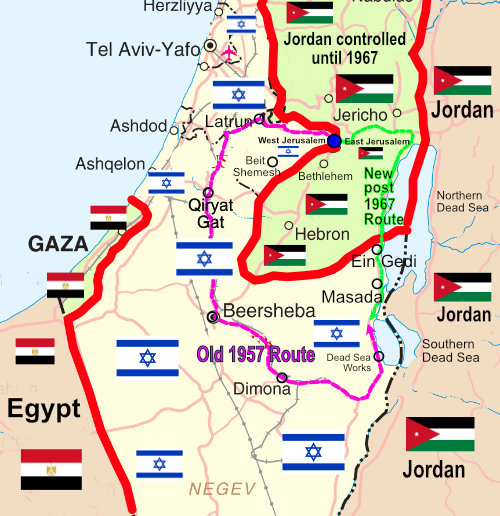
There was no direct route from Jerusalem to the Dead Sea in 1957 and one could access the southern part of the Dead Sea – the Northern Dead Sea was controlled by Jordan and not accessible to Jews and Israelis.
The only way to get to the Dead Sea then was via a very long, round-about route. It meant traveling from Jerusalem west to Latrun, and then going south to Beer Sheva and then east, passing what is now known as Arad, until finally reaching the southern Dead Sea.
In total, the ride from Jerusalem to the Southern Dead Sea took approximately four hours on mostly unmaintained and windy roads.
Today, it takes about thirty minutes to reach the Northern Dead Sea and one and a half hours to reach the Southern Dead Sea when traveling directly east from Jerusalem.
(In 1957 Judea and Samaria – also known as the West Bank – was controlled by Jordan and one could not travel directly east from Jerusalem to the Dead Sea.)
”We stopped at the Dead Sea and saw the potash & bromide factories. They have huge salt drying ponds. Loads of trucks carry out the Potash & Bromide for use as exports, fertilizers & of course explosives. “
“I then went for a swim into the Dead Sea. You could stay on top of the water and can’t drown even if you wanted to. I swam almost a third of the way and paddled back on my back. It felt great.”