
Immigration to Israel
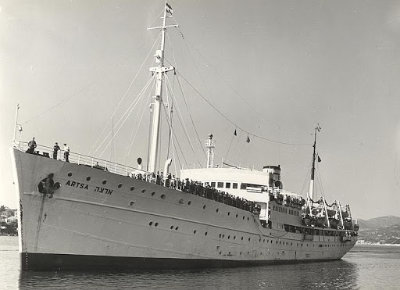
“ The S.S. Artza landed & with some more of the escapees from behind the iron curtain pulled in right in front of me.”
“One of the most interesting things I have seen since being in Israel is a refugee being unloaded & the people cared for.”
“The excited and screaming faces are something I will never forget as they looked down into the Promised Land.”
“The greatest was when a refugee recognized a long lost relation in the crowd below the screams that you heard."
“The pitiful sight of the cartons crammed with all their earthly belongings, of little children not knowing what is going on. But the best was as they came down the gangplank & embraced loved ones that many hadn't seen in tens of years.”
“ I even felt like crying for joy with them."
August 25, 1957
“ We saw the homes of the new immigrants who were settling in the South.”
“We then passed a Maaraba which houses new refugees”
“ I'm sorry to say that once again as in 48 there just aren't enough homes to accommodate the flood from all over the world”
July 23, 1957 - Night

David's Comments
What was it like to see Jewish immigrants arriving from all parts of the world?
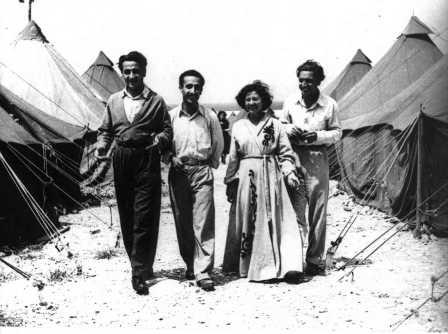
A "ma'abra" which temporarily housed
new immigrants from North Africa
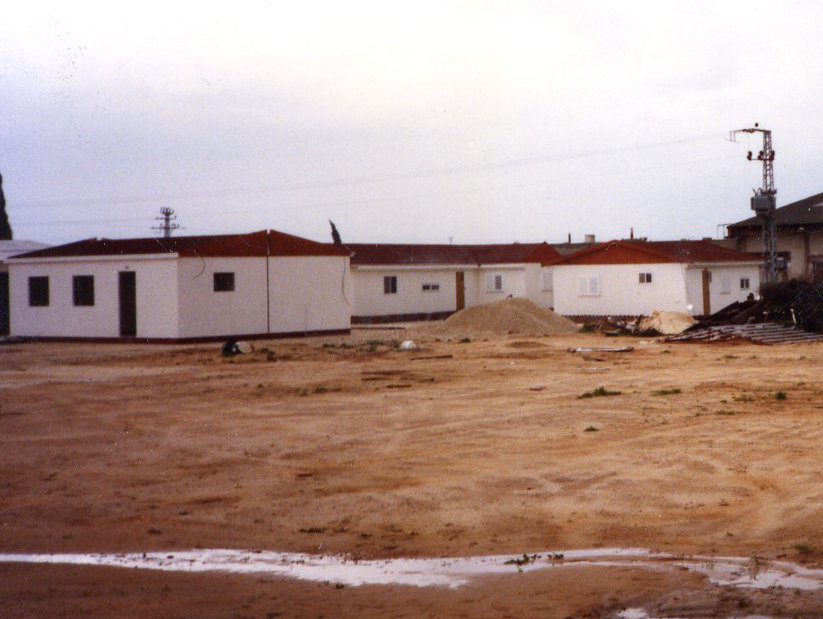
Pre-fab housing built in 1991 by the Jacobs family, together with
an Israeli builder for immigrants from Russia and Ethiopia.
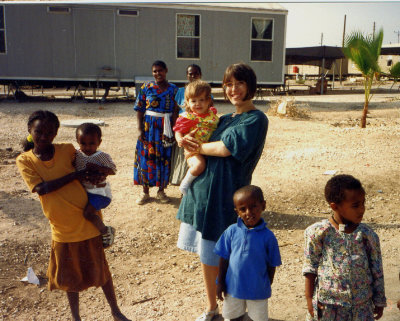
My wife Debra and baby daughter Meira at a pre-fab housing site
of Ethiopian immigrants, 1992
Immigration to Israel in the early years of the State
The early years of the State of Israel were noted for the large wave of immigration from all over the world. During its first three and a half years, 688,000 new immigrants arrived in Israel, doubling its population. The immigrants were mostly Holocaust survivors from Europe and refugees from Arab countries. My father's excitement upon seeing these immigrants arrive is self-explanatory. This welcome influx of Jews to Israel required many resources, and the new immigrants needed housing and jobs.
Ma’abara
The ma’abarot my father refers to were the transit camps that were built to accommodate the large influx of Jewish immigrants who came to Israel in the 1950s. (The word ma’abara derives from the Hebrew word "ma’avar" meaning move or transit.) My father's letters bear witness to the difficult conditions in these communities. The inhabitants were exposed to the heat of the summer and the rain and mud of the winter. Of course, they were intended to be temporary places of residence until the immigrants found permanent homes
Aliya from North African Countries
The first large-scale exoduses took place in the late 1940s and early 1950s, primarily from Iraq, Yemen and Libya. In these cases over 90% of the Jewish population left, despite the necessity of leaving their property behind. They were motivated both by Zionism and the fear of living in an Arab country after Israel’s victory in the War of Independence in 1948. Two hundred and sixty thousand Jews from Arab countries immigrated to Israel between 1948 and 1951, accounting for 56% of the total immigration to the newly founded state.
S.S. Artza
The S.S. Artza which my father observed in Haifa was one of the vessels that brought in these new immigrants. A 1957 article from the archives of the Jewish Telegraphic Agency actually mentions part of what my father witnessed: "More than 600 Egyptian Jews who had spent the Sabbath aboard the vessel S. S. Mediterranean outside the port of Haifa were taken off the vessel today. The immigrant ship arrived off the port Saturday morning, but since the port was closed for the Sabbath, the vessel was not docked. The S. S. Artza with another 500 immigrants, is expected to arrive today."
Ethiopian Jews
One of the greatest immigration stories in the world was the daring "Operation Solomon". On May 24, 1991, the Israeli Air Force carried 14,500 Ethiopian Jews to Israel soil. (The Ethiopian government had prohibited its citizen from emigrating to Israel.) This massive airlift included 34 planes and took 36 hours to complete. The mission remains the largest aerial expedition in Israel’s history. As Major General Avihu Ben Nun explained: “Operation Solomon truly represents what Zionism is demonstrates the purpose for the State of Israel: to provide a home and shelter for Jews around the world who have suffered and were prosecuted merely for bearing the Jewish religion.”
Jacobs Family invests in Israeli pre-fab housing for new immigrants
During this time, there was a massive aliyah from the Soviet Union as well, and Israel was hard pressed to take in all these new immigrants. My father got involved and invested in a modular housing factory in Israel to help accommodate this new wave of immigrants.
In the late 1980’s the State of Israel had to absorb over 1,000,000 new immigrants from the former Soviet Union and Ethiopia. To accommodate this massive aliyah, Israel needed a quick housing solution. Since it would take too long to build permanent housing,It was decided to import mobile homes and caravans from the US and other countries.
At the time the Jacobs Family were co-owners of a large modular housing factory in Pennsylvania and New York. The office of David Levy, Israel's Minister of Housing, approached Bob about importing his prefab houses to Israel. Bob turned the conversation around: "Rather than exporting these homes to Israel, wouldn't it be better if we opened a factory in Israel and assembled the houses there? This would certainly save on shipping costs and even more importantly, it would provide jobs for new immigrants and army veterans."
MK Michael Kleiner, Chairman of Knesset Aliyah Committee and also a good friend of Bob, helped turn this idea into a reality. He introduced Bob to Shmuel Maidenberg who owned a small modular housing factory in Moshav Azeret. The Jacobs Family invested in this factory with the purpose of expanding it's capabilities of producing as many homes as possible. Bob also encouraged his colleagues in New York to follow suit and invest in other Israeli modular home companies.
The houses would be produced in Israel giving jobs to new immigrants and other Israelis.
The houses would be built by Israeli building codes and use 220 electric.
The imported houses that Israel later ordered did not conform to the Israeli building codes and climate and later fell apart.
(use picture of David and Debbie with the Ethiopian Jews, picture of modular houses, there is also a ton on this subject of Bob's involvement in the Israeli factories and modular housing in the book, at the end of the economic chapter)
1957 vs today
In 1957, Ixxxxxxx.
Today, Txxxxxxxx
LINKS:
Video of Jewish refugees housed in ma’abarot: https://vimeo.com/448248565