
Dead Sea Experience
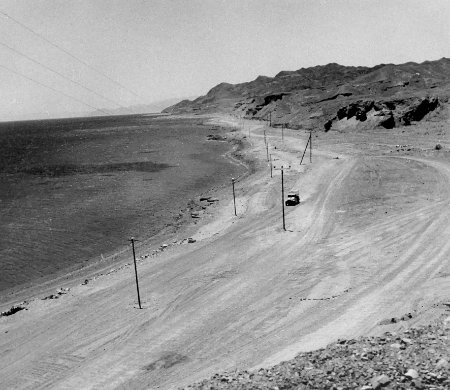
Travelling on the Dead Sea road in the 1950's was certainly different than today.
"From Be’er Sheva we moved south along the Dead Sea."
“I then went for a swim into the Dead Sea. You could stay on top of the water and can’t drown even if you wanted to. I swam almost a third of the way and paddled back on my back. It felt great."
“We stopped at the Dead Sea and saw the potash & bromide factories. They have huge salt drying ponds.”
“Loads of trucks carry out the Potash & Bromide for use as exports, fertilizers & of course explosives.”
July 23, 1957 - 2pm & night

David's Comments
The Dead Sea, know in Hebrew as the "Salt Sea" is a "must see".
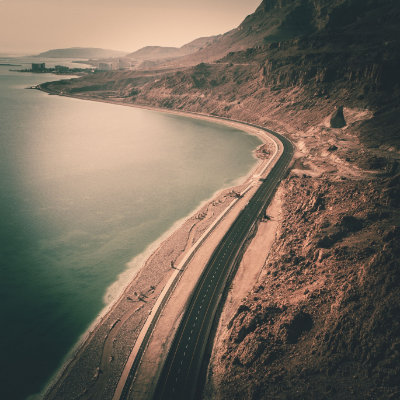
Still a winding and dangerous road, but a vast improvement
since 1957
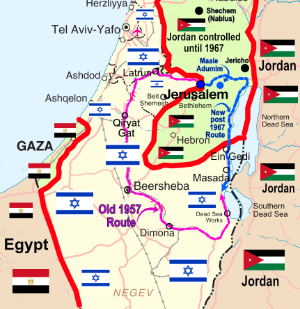
Violet Route: Old 1957 roundabout route from Jerusalem to the Dead Sea via Beersheba
Blue Route post-1967: Today's road going East from Jerusalem directly to the Dead Sea, passing the new Israeli city
of Maale Adumim.
Red lines: Egyptian border to the south and Jordan border east of Jerusalem extending to northerly and southerly directions leaving no direct access to the Dead Sea for Israel
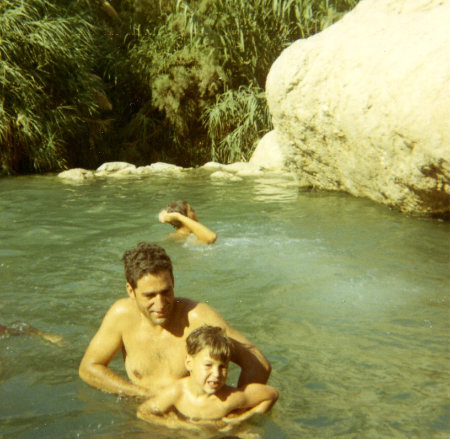
Bob with his son David at the Ein Gedi springs in 1970 during his children's first trip to Israel.
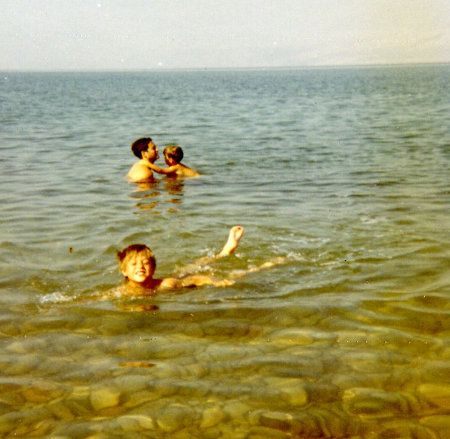
Bob with his two sons Elliot and David during a visit to the Dead Sea.
Why is the Dead Sea Considered One of the Seven Natural Wonders of the World?
The Dead Sea, known in Hebrew as Yam Ha-Melech (the Salt Sea) is surrounded by the stunning landscape of the Negev Desert, and is the lowest point on earth. The extremely high concentration of saline water in the sea gives lead to the name "Dead Sea", being that no fish can survive in these waters. Its salty water is known for its health and healing properties. Another unique aspect of the Dead Sea waters is, as my father wrote, "You can stay on top of the water and cannot drown, even if you wanted to."
Pre-1967: A long, roundabout, rough ride from Jerusalem to the Dead Sea
There was no direct route from Jerusalem to the Dead Sea in 1957. Israelis could only access the southern part of the Dead Sea since the northern Dead Sea was controlled by Jordan and off limits to Jews and Israelis. The only way to get to the Dead Sea then was via a very long, round-about route. It meant traveling from Jerusalem west to Latrun, and then going south to Beer Sheva and then east, passing what is now known as Arad, until finally reaching the southern Dead Sea.
In total, the ride from Jerusalem to the Southern Dead Sea took approximately four hours on mostly unmaintained and windy roads. Today, it takes about thirty minutes to reach the Northern Dead Sea and one and a half hours to reach the Southern Dead Sea when traveling directly east from Jerusalem. (In 1957 Judea and Samaria – also known as the West Bank – was controlled by Jordan and one could not travel directly east from Jerusalem to the Dead Sea.)
Where was Masada? Where was Ein Gedi?
Notably missing from the sites my father visited during his trip to the Dead Sea is "Masada", which today is one of the most iconic sites in Israel, and one of the favorite pilgrimage locations for Jewish youth groups. Masada is an ancient fortress in southern Israel’s Judean Desert built around 30 B.C.E. It's on a massive plateau overlooking the Dead Sea. Herod the Great, King of Judea, originally built Masada as a castle complex. The large complex later served as the last Jewish stronghold in the Great Revolt against Rome. Even after the Temple was destroyed in 70 CE, the residents of Masada held out for another three years. When they saw that defeat was imminent, they committed mass suicide instead of surrendering.
While Masada is one of the most popular tourist destinations in Israel today, in 1957 Masada stood isolated with no paved roads. Access to sites like Masada and Ein Gedi was limited to jeeps and other off road vehicles. Certainly, there were no tour buses or commercial vehicles.
Those who did visit Masada during these times were archaeologists who began light excavations. In 1963, the excavations intensified, and in 1966, the site was declared a national park by the Israel Nature and Parks Authority, with a cable car scaling the mountain built in 1977.
During this time, a road along the Dead Sea was paved, making access to the area much easier. Once the roads were paved, the bus tours began. In time, large parking lots, public bathrooms and restaurants to accommodate the wave of visitors were established. By the 1970’s, luxurious hotels were built, along with a tourism complex that capitalized on the underlying attributes of the Dead Sea area.
Ein Gedi
Once access to the Dead Sea area improved, other sites besides Masada turned into premier hiking spots. One of these must-visit sites is Ein Gedi, which is located in the Judean Desert, on the eastern shore of the Dead Sea. Ein Gedi is the largest oasis in Israel, with springs and waterfalls which flow from the brooks at the foot of the cliffs. Even though the Dead Sea region is barren desert with minimal rainfall, the tiny area of Ein Gedi is flowing with natural water all year round. When my father returned to Israel in 1970 as a married man with four children, he would always take us to the Dead Sea, and then to Ein Gedi. The contrast between these two sites, so close to one another, always amazed me. We went from a place where the water was totally undrinkable, to an oasis of delicious spring water. Only in Israel!
Ahava Dead Sea Products - History
The Ahava factory is located in the northern Dead Sea area which was under Jordanian rule in 1957.. Ahava was founded in 1988 as a single stand selling bottles of body scrub to tourists, generating $1 million that year. A spa technician came up with the idea of marketing Dead Sea mud after watching women tourists scooping up the mud to take home As of 2010, Ahava is the only cosmetics company licensed by the Israeli government that is legally permitted to mine raw materials at the Dead Sea and selling it's products all over the world.
1957 vs today
In 1957, Ixxxx
Today, Txxx
LINKS:
Floating in the Dead Sea: https://youtu.be/VhkijfRtMOo
Benefits of Dead Sea Minerals: https://www.deadsea.com/articles-tips/health-benefits/minerals-of-the-dead-sea/
All about the Dead Sea Works (info page) : https://www.deadsea.com/articles-tips/the-dead-sea-works-potash-mining/
All about the Dead Sea Works (video) : https://www.youtube.com/watch?v=bOq3VxXwRp8&feature=youtu.be
10 Things to Know Before Visiting the Dead Sea: https://theculturetrip.com/middle-east/israel/articles/10-things-to-know-before-visiting-the-dead-sea/
Historic significance of Ein Gedi: https://youtu.be/CeGa6T0_Auo