
August 15
Metulah and Hulah Valley
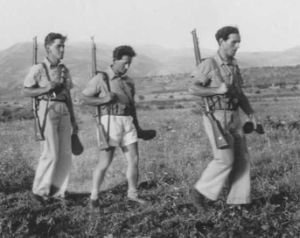
The British handed the area to the Arabs. “We had to capture it with almost no weapons.”
Bob visiting Metulah and Hulah Valley
Thursday Aft. 12:30 PM, August 15, 1957
Dear Mom Dad & Alan
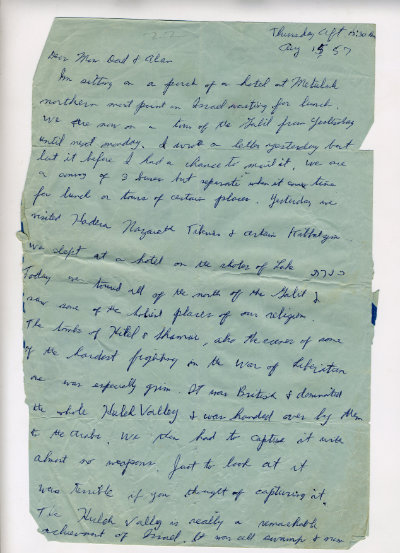
I’m sitting on a porch of a hotel at Metulah northern most point in Israel waiting for lunch. We are now on a tour of the Galil from yesterday until next Monday. I wrote a letter yesterday but lost it before I had a chance to mail it. We are a convoy of three buses but separate when it comes time for lunch or tours of certain places.
Yesterday we visited Hadera, Nazareth, Tiberias and certain kibbutzim. We slept at a hotel on the shores of Lake Kinneret כנרת. Today we toured all of the north of the Galil & saw some of the holiest places of our religion. The tombs of Hillel & Shamai, also the scene of some of the hardest fighting in the War of Liberation with one war especially grim. It was British and dominated the whole Huleh Valley and was handed over by them and the Arabs. We then had to capture it with almost no weapons. Just to look at it was terrible if you thought of capturing it.
The Huleh Valley is really a remarkable achievement of Israel. It was all swamp and now you see all green except when in between planting you see Black earth.
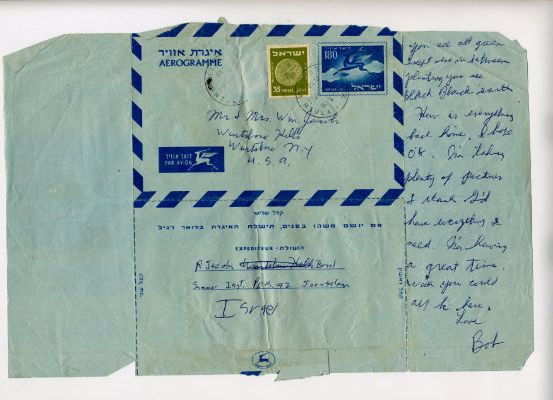
How is everything back home? I hope OK. I’m taking plenty of pictures and thank God have everything I need. I’m having a great time.
Wish you could all be here.
Love, Bob
David’s Comments:
Visiting Metulah, Kinneret, Tzfat, Hulah Valley
“I am sitting at a hotel at Metulah northern most point in Israel.”
Metula is a town in the far north of Israel bordering Lebanon.
“I wrote a letter yesterday but lost it before I had a chance to mail it.”
My father knew how important his letters were to his parents. When one got lost, he immediately wrote another one, since showing respect to his parents was paramount in his eyes.
“Yesterday we visited Hadera, Nazareth, Tiberias and certain kibbutzim”
Hadera, Nazareth and Tiberias are relatively short drives from one to the other and easy to tour in one day.
“Today we toured all of the North of the Galil and saw some of the holiest places of our religion. The tombs of Hillel and Shamai…”
In 1957 Judea and Samaria were not controlled by Israel. Places like the Kotel, Shchem and Hebron were not in Jewish hands. That’s why the burial site of Shamai and Hillel in Meron were considered the “holiest sites” of that time.
In 1967, Judea, Samaria (the West Bank) and East Jerusalem were liberated. Jews now have access to the burial places of Abraham, Isaac Jacob, Sara, Rivka and Leah who were buried in Hebron. Rachel was buried in Bethlehem, Joseph in Shechem and Joshua in the Shomron.
Today, people who visit Israel’s holy sites may not even make the time to visit the graves of Hillel and Shami.
The graves of Hillel and Shamai are located in Meiron, which is a suburb of the city of Tzfat. Many famous Rabbis are also buried there, including Rabbi Shimon Bar Yochai.
Hillel and Shamai were famous Rabbis who disagreed over the interpretation of the Law, but still got along with one another.
Hillel was known for his lenient views, which often conflicted with the strict stance of Shammai who was the other leading scholar of that time.
Elaines’s Comments of Bob’s August 15th Letter:
“We are a convoy of 3 buses but separate when it comes time for lunch or tours of certain places.”
Elaine:
“The youth groups had 3 buses Bob always managed to get on my bus.”
“Today we toured all of the North of the Galil and saw some of the holiest places of our religion. The tombs of Hillel and Shamai.”
Elaine:
“I remember in 1968 how special it was when Bob and I were able to visit Rachel’s tomb, the Cave of the Patriarchs and the Kotel which we weren’t able to do during our 1957 visit. On later trips to Israel we were also able to visit Shilo, Bet El, Josephs Tomb and many other places Jews did not have access to in 1957.”
See attached pictures Need to prepare video.
“Today we toured all of the North of the Galil….. also the scene of some of the hardest fighting in the War of Liberation. It was British and dominated the whole Huleh Valley and was handed by them and the Arabs. We then had to capture it with almost no weapons.”
Elaine:
“When Bob wrote, ‘we had to capture it with almost no weapons’, I think he was referring to the City of Tzafat (Safed) and the “Davidka” weapon which we saw on display there. They explained to us that the Davidka made loud noises and scared the Arab enemy but did not really cause any damage.”
“The Huleh Valley is really a remarkable achievement of Israel. It was all swamp & now you see all green except when in between planting you see Black earth.”
Elaine:
“I remember going there. I had never seen such beautiful nature. It is a must to visit when visiting Northern Israel.”